I was today days old when I learned there’s a free browser extension that quietly cleans the fake brands out of Amazon search results — the SZHLUXes, the HORUSDYs, the all-caps nonsense-word brands that show up above things you actually recognize. It’s called Knockoff, it’s free for Chrome and Firefox, and it went viral within days of shipping in July 2026 because it turns out almost everyone has felt this exact same low-grade Amazon fatigue and just never had a name for it. Source: Knockoff.
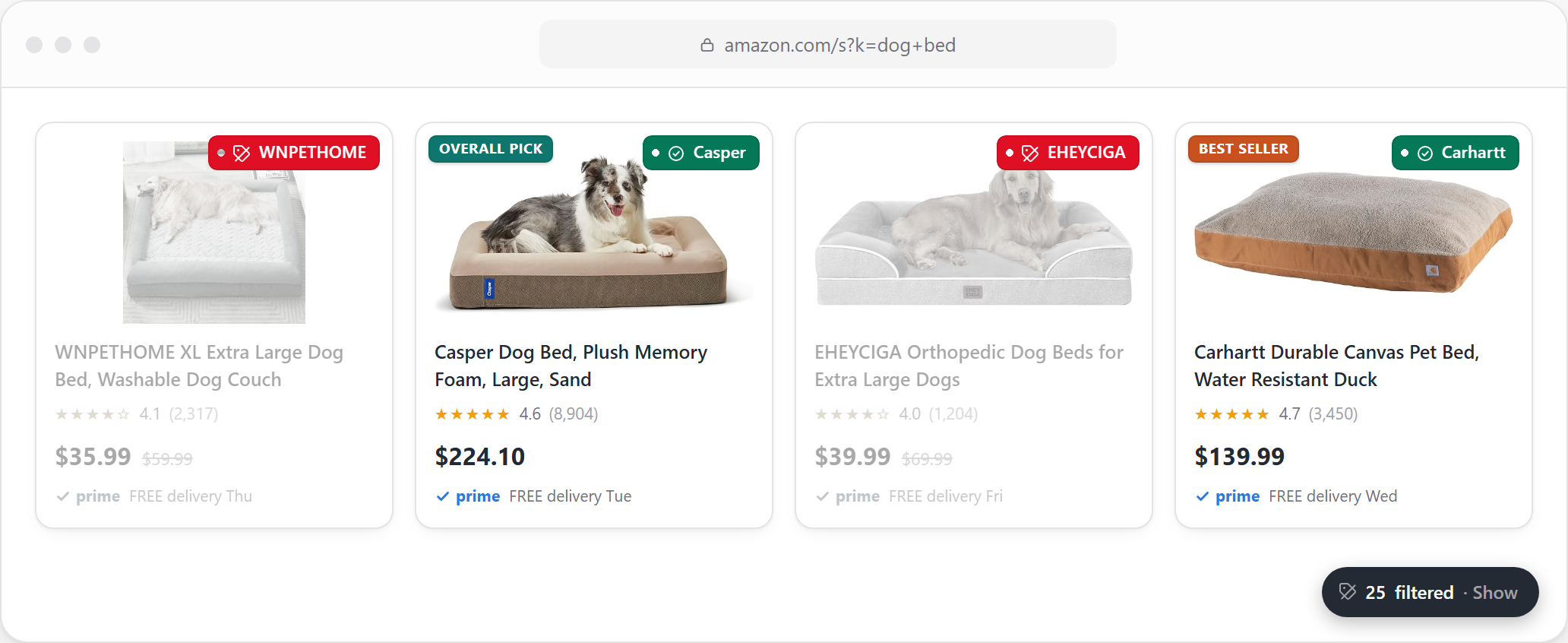
The Problem: Amazon Brand Registry Turned Nonsense Words Into a Business Model
The junk brands aren’t random. Amazon Brand Registry lets any seller who trademarks a name unlock better placement, protection from listing hijackers, and access to premium ad formats — so a whole industry sprang up around registering meaningless strings (SZHLUX, HORUSDY, LATTOOK, DOZAWA) purely to qualify, with no actual company, warranty, or reputation behind them. Knockoff’s own description of the problem is blunt: these are “trademark-squat ‘brands’… selling commodity goods with no company, no warranty, and no reputation behind them.” Source: Knockoff, GitHub README.
Built Because a Weed Eater Wouldn’t Crank
The extension is the work of developer Josh Pigford, and the origin story is almost aggressively mundane. In his own words to 404 Media: “I was cutting the grass and about to get my trimmer out to do some weed eating, and it wouldn’t crank. So I decided to get some specific tools, and I searched for them and was like ‘What are these brands? Am I going insane?’ I just wanted something from a common brand or something I was familiar with. I was like ‘man, I’ve gotta build something.’” He announced it on X with a shoutout that doubled as a demonstration of the problem: “Sorry to brands like WNPETHOME, EHEYCIGA, YXYL, LU&MN, JOYIN, TOMY, GODONLIF, YOOJEE, LINGTENG, LANEIGE, VISCOO, BIODANCE, COOFANDY, BALENNZ, TOSY, and LUENX.” It went viral almost immediately. Source: 404 Media, Jason Koebler.
How It Actually Decides What’s Junk
Every product tile’s brand runs through a pipeline, first match wins: your personal allowlist, your personal blocklist, then a seed list of known notorious pseudo-brands, then a separate list of established Chinese-owned brands, then a broader list of roughly 5,000 established, recognizable brand names — a curated list plus a community-maintained allowlist that refreshes daily from Knockoff’s own API. Anything that doesn’t match any of those gets scored by name heuristics: ALL-CAPS strings in the 5–9 character range, vanishing vowel ratios, unpronounceable consonant runs, letter pairs that don’t occur in English, non-Latin characters, and randomly-capitalized “iNternal caPitalization.” The known-brands list always overrides the heuristics, specifically so real brands that happen to look a little odd — ASICS, RYOBI, HOKA are the maintainers’ own examples — don’t get caught in the net. Source: Knockoff, GitHub README.
That name-based approach is deliberate. The maintainers considered actually looking up each seller’s registered country of origin, but ruled it out: it would cost two rate-limited page fetches per product, and Amazon serves 503 errors to scrapers that hit it that hard. Scoring the brand name itself needs zero extra network calls. Source: Knockoff, GitHub README.
Three Filter Levels, Three Ways to Handle a Flagged Listing
Filtering runs at one of three levels: Relaxed only catches known pseudo-brands plus whatever you’ve personally blocked; Standard, the default, adds suspect-looking names and listings with no brand at all; Strict goes allowlist-only, filtering anything that isn’t on a known-brands list. Whatever gets caught can be handled three ways: hidden entirely, with a small floating pill showing the count and a one-click reveal; dimmed, faded and desaturated until you hover over it; or just labeled with a warning chip so you can decide for yourself. Every badge is clickable, letting you trust a brand, block it, view the item once anyway, or flag a misclassification for the maintainers to review by hand. Source: Knockoff, GitHub README.
Per BGR’s coverage, Knockoff also strips out paid sponsored listings as part of the same pass — another category that clutters search results for reasons that have nothing to do with product quality. Source: BGR.
Runs Entirely on Your Machine, Free, Fair-Source Licensed
Everything happens locally in a browser content script — no account, no login, and per the maintainers, the daily brand-list refresh is the only network request the extension makes on the shopping path itself. Knockoff is licensed FSL-1.1-MIT, a “fair source” license under which the code converts to plain MIT after two years; it’s free to install, free to read, and works on any Amazon marketplace worldwide, not just amazon.com. Available now from the Chrome Web Store and Firefox Add-ons, with a native Safari wrapper in the same GitHub repo for anyone willing to build it themselves in Xcode. Source: Knockoff, GitHub README, Knockoff.
By its own homepage count, more than 75,000 people are already shopping with Knockoff installed every day, and the press run since launch has been unusually broad for a single-developer browser extension — Fast Company, 404 Media, Gizmodo, PC Gamer, Yahoo, Lifehacker, BGR, Digital Trends, and Boing Boing have all covered it within the same couple of weeks. Source: Knockoff.
It won’t fix Amazon’s incentive structure — Brand Registry still rewards exactly this kind of trademark squatting, and Knockoff can only filter what you can already see. But for the specific, recognizable feeling of scrolling past twelve unpronounceable brand names before finding one you trust, it’s a genuinely useful, genuinely free fix, built by one person who got tired of it during yard work.